
Thirty-five minutes is a very common 5K time. It is where a lot of people land after their first few months of running, and it is a big step up from walking parts of the course. Here is what 35 minutes means in km and miles, how it compares with real race and parkrun results, and what it predicts for longer races. Every time on this page is worked out from the distance and the clock, so the numbers always add up.
35-minute 5K pace in every unit
| Measure | 35:00 for 5K equals |
|---|---|
| Pace per km | 7:00 |
| Pace per mile | 11:16 |
| Speed in km/h | 8.6 km/h |
| Speed in mph | 5.3 mph |
| One 400 m track lap | 2:48 |
| Distance in miles | 3.11 mi |
The easy number to remember is 7:00 per km: seven minutes for every kilometre. In the UK and Australia most watches show km, so that is all you need to know. In the US, aim for 11:16 per mile. That is a bit faster than a 12-minute mile, which gives a 5K of about 37:17.
Your splits for a 35-minute 5K
| Distance passed | Clock time |
|---|---|
| 1 km | 7:00 |
| 2 km | 14:00 |
| 3 km | 21:00 |
| 4 km | 28:00 |
| 5 km | 35:00 |
| 1 mile | 11:16 |
| 2 miles | 22:32 |
| 3 miles | 33:48 |
If you pass 3 miles at 33:48, you only have about 170 metres left. For more on that distance, see how long it takes to run 3 miles.
How a 35-minute 5K compares with real runners
Here is how 35:00 stacks up against real results, as of November 2026:
| Group | 5K time | Per km | Per mile |
|---|---|---|---|
| Average US 5K finisher (2018) | 39:02 | 7:48 | 12:34 |
| Average US man (2018) | 35:22 | 7:04 | 11:23 |
| Average US woman (2018) | 41:21 | 8:16 | 13:19 |
| Median man, US 5K (50th percentile) | 31:18 | 6:16 | 10:04 |
| Median woman, US 5K (50th percentile) | 36:24 | 7:17 | 11:43 |
| Average UK parkrun | 29:30 | 5:54 | 9:30 |
| Average Australia parkrun | 33:25 | 6:41 | 10:45 |
| Average USA parkrun | 34:16 | 6:51 | 11:02 |
| You, at 35 minutes | 35:00 | 7:00 | 11:16 |
Sources: RunRepeat’s US 5K stats page (US race results, last updated November 2023; averages are from 2018; parkrun not included) and The Running Channel’s average parkrun times (as of August 2025, walkers included). The “faster than” shares are worked out by Run&Grow between the nearest rows of RunRepeat’s percentile table (men: 34:15 and 38:17; women: 33:20 and 36:24), so treat them as close estimates.
So what does it mean? In a typical US 5K, 35 minutes puts you in the faster half of women and a little behind the middle for men (the median man runs 31:18). You also beat the average US man (35:22) by a few seconds. At parkrun it is close to average in Australia (33:25) and the USA (34:16). UK parkrun fields are quicker, with an average of 29:30. For the full picture by age, see average 5K time by age and gender.
Run&Grow · free iPhone app
Every 5K counts, at any pace
- Free on iPhone
- Reads your runs from Apple Health
- No public feed, no pace shaming

4.6 on the App Store
Goal times near 35 minutes
Working toward 35, or ready to chase 30? These are the paces you need for each finish time:
| 5K time | Per km | Per mile | km/h | mph |
|---|---|---|---|---|
| 30:00 | 6:00 | 9:39 | 10.0 | 6.2 |
| 31:00 | 6:12 | 9:59 | 9.7 | 6.0 |
| 32:00 | 6:24 | 10:18 | 9.4 | 5.8 |
| 33:00 | 6:36 | 10:37 | 9.1 | 5.6 |
| 34:00 | 6:48 | 10:57 | 8.8 | 5.5 |
| 35:00 | 7:00 | 11:16 | 8.6 | 5.3 |
| 36:00 | 7:12 | 11:35 | 8.3 | 5.2 |
| 37:00 | 7:24 | 11:55 | 8.1 | 5.0 |
| 38:00 | 7:36 | 12:14 | 7.9 | 4.9 |
| 40:00 | 8:00 | 12:52 | 7.5 | 4.7 |
Every minute off your 5K is 12 seconds per km, or about 19 seconds per mile. The next big goal for most people is a 30-minute 5K, which needs 6:00 per km. After that comes the 25-minute 5K.
What a 35-minute 5K predicts for longer races
| Distance | At the same pace | Predicted (Riegel) |
|---|---|---|
| 10K (6.2 mi) | 1:10:00 | 1:12:58 |
| Half marathon (13.1 mi) | 2:27:41 | 2:41:00 |
| Marathon (26.2 mi) | 4:55:22 | 5:35:41 |
Nobody holds their 5K pace for a marathon, so the last column uses the Riegel formula (time × (distance ratio)1.06), which adds a little time as races get longer. It assumes you have trained for that distance. Try your own numbers in the race time predictor, or compare with is a 1-hour 10K good.
How to get from 35 minutes to faster
- Run three times a week. Keep most runs easy, at a pace where you can still talk. Still taking walk breaks? Our couch to 5K plan or the run-walk interval calculator can help.
- Add one faster session. For example, 6 × 2 minutes a little quicker than 7:00 per km, with 2 minutes of easy jogging or walking between.
- Make one run a bit longer. Building up to 6 or 7 km makes 5 km feel easier.
- Start steady on race day. Use the split table above. Going out too fast in the first km usually costs you more later.
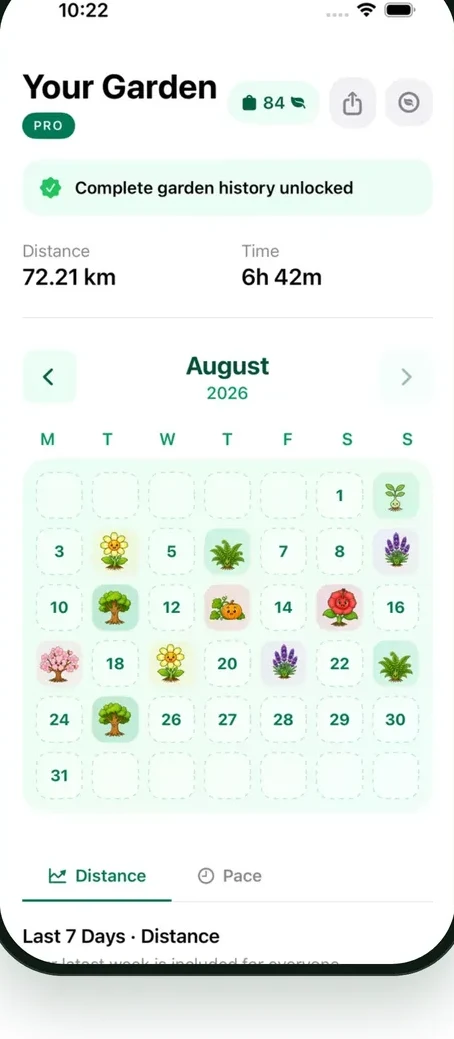
When you are ready for sub-30, our 5K in 30 minutes training plan lays it out week by week. The hardest part is not one workout, it is showing up for months. That is where Run&Grow helps: every GPS run grows a plant in your garden, so a slow jog counts just as much as a fast one. It reads runs from Apple Health, so runs saved from your Apple Watch or another app count too. No public feed and no pace shaming.
Nearby times and tools
30-minute 5K · 25-minute 5K · How long to run 3 miles · 12-minute mile · 10-minute mile · Average 5K time · Pace calculator · Couch to 5K calculator
Frequently Asked Questions
- Is a 35 minute 5K good?
- Yes, it is a solid time. A 35-minute 5K is 7:00 per km (11:16 per mile). That is about 4 minutes faster than the average US 5K finisher (39:02) and faster than roughly 55% of women and 38% of men in US race results.
- What pace is a 35 minute 5K?
- 7:00 per kilometre, or 11:16 per mile. On a treadmill that is 8.6 km/h or about 5.3 mph. Each kilometre should tick over in exactly seven minutes.
- Is a 35 minute 5K good for a beginner?
- Yes. Many people finish their first 5K in 35 to 40 minutes, often with a few short walk breaks. Running the whole way in 35 minutes is a great result for a first race or a first parkrun.
- Is a 35 minute parkrun good?
- It is close to average. As of August 2025 the average parkrun time was 29:30 in the UK, 33:25 in Australia and 34:16 in the USA. So 35 minutes is a little behind the average in Australia and the USA, and about five and a half minutes behind the UK average, where fields are quicker. Walkers are included in those averages.
- How long will it take to go from a 35 minute 5K to 30 minutes?
- Going from 35 to 30 minutes means running each km about 60 seconds faster (7:00 down to 6:00). With three runs a week, many newer runners get there in about three to six months. It depends on age, weight, sleep and how regularly you run.
Picking an app to time your 5K? Map My Run and Strava both record pace and splits for free. See Map My Run vs Strava for how they differ and what the paid plans add.
Run&Grow · free iPhone app
Keep running, keep growing
- Free on iPhone
- Reads your runs from Apple Health
- No public feed, no pace shaming
4.6 on the App Store