
Twenty minutes is the 5K goal many keen runners chase. “Sub-20” is a badge of honour at parkrun and in running clubs. Here is what 20 minutes means in km and miles, how rare it is among real runners, and what it predicts for longer races. Every time on this page is worked out from the distance and the clock, so the numbers always add up.
20-minute 5K pace in every unit
| Measure | 20:00 for 5K equals |
|---|---|
| Pace per km | 4:00 |
| Pace per mile | 6:26 |
| Speed in km/h | 15.0 km/h |
| Speed in mph | 9.3 mph |
| One 400 m track lap | 1:36 |
| Distance in miles | 3.11 mi |
The easy number to remember is 4:00 per km: four minutes for every kilometre. In the UK and Australia most watches show km, so that is all you need. In the US, aim for 6:26 per mile. That is well under an 8-minute mile, which gives a 5K of about 24:51.
Your splits for a 20-minute 5K
| Distance passed | Clock time |
|---|---|
| 1 km | 4:00 |
| 2 km | 8:00 |
| 3 km | 12:00 |
| 4 km | 16:00 |
| 5 km | 20:00 |
| 1 mile | 6:26 |
| 2 miles | 12:52 |
| 3 miles | 19:19 |
If you pass 3 miles at 19:19, you have about 170 metres left, which takes roughly 40 seconds at this pace. For more on that distance, see how long it takes to run 3 miles.
How a 20-minute 5K compares with real runners
Here is how 20:00 stacks up against real results, as of November 2026:
| Group | 5K time | Per km | Per mile |
|---|---|---|---|
| Average US 5K finisher (2018) | 39:02 | 7:48 | 12:34 |
| Average US man (2018) | 35:22 | 7:04 | 11:23 |
| Average US woman (2018) | 41:21 | 8:16 | 13:19 |
| Fastest 10% of US men | 22:06 | 4:25 | 7:07 |
| Fastest 10% of US women | 25:16 | 5:03 | 8:08 |
| Fastest 1% of US men | 17:49 | 3:34 | 5:44 |
| Fastest 1% of US women | 19:29 | 3:54 | 6:16 |
| Average UK parkrun | 29:30 | 5:54 | 9:30 |
| Average Australia parkrun | 33:25 | 6:41 | 10:45 |
| Average USA parkrun | 34:16 | 6:51 | 11:02 |
| You, at 20 minutes | 20:00 | 4:00 | 6:26 |
Sources: RunRepeat’s US 5K stats page (US race results, last updated November 2023; averages are from 2018; parkrun not included) and The Running Channel’s average parkrun times (as of August 2025, walkers included). The “faster than” shares are worked out by Run&Grow between RunRepeat’s 1st and 10th percentile rows (men: 17:49 and 22:06; women: 19:29 and 25:16). That gap is wide, so treat them as rough estimates.
So what does it mean? 20:00 is faster than the fastest 10% of US men (22:06) and close to the fastest 1% of US women (19:29). It is about half the time of the average US finisher. At parkrun, where walkers are included, it is 9:30 ahead of the UK average and often puts you near the front. For the full picture by age, see average 5K time by age and gender.
Run&Grow · free iPhone app
Every 5K counts, at any pace
- Free on iPhone
- Reads your runs from Apple Health
- No public feed, no pace shaming

4.6 on the App Store
Goal times near 20 minutes
Working toward sub-20, or already there and chasing 18? These are the paces you need for each finish time:
| 5K time | Per km | Per mile | km/h | mph |
|---|---|---|---|---|
| 17:00 | 3:24 | 5:28 | 17.6 | 11.0 |
| 18:00 | 3:36 | 5:48 | 16.7 | 10.4 |
| 19:00 | 3:48 | 6:07 | 15.8 | 9.8 |
| 20:00 | 4:00 | 6:26 | 15.0 | 9.3 |
| 21:00 | 4:12 | 6:46 | 14.3 | 8.9 |
| 22:00 | 4:24 | 7:05 | 13.6 | 8.5 |
| 23:00 | 4:36 | 7:24 | 13.0 | 8.1 |
| 24:00 | 4:48 | 7:43 | 12.5 | 7.8 |
| 25:00 | 5:00 | 8:03 | 12.0 | 7.5 |
| 27:00 | 5:24 | 8:41 | 11.1 | 6.9 |
Every minute off your 5K is 12 seconds per km, or about 19 seconds per mile. Most runners reach 20 minutes in steps: first a 25-minute 5K (5:00 per km), then 22 minutes (4:24 per km), then sub-20. If you are newer, the 30-minute 5K page is a better place to start.
What a 20-minute 5K predicts for longer races
| Distance | At the same pace | Predicted (Riegel) |
|---|---|---|
| 10K (6.2 mi) | 40:00 | 41:42 |
| Half marathon (13.1 mi) | 1:24:23 | 1:32:00 |
| Marathon (26.2 mi) | 2:48:47 | 3:11:49 |
Nobody holds their 5K pace for a marathon, so the last column uses the Riegel formula (time × (distance ratio)1.06), which adds a little time as races get longer. It assumes you have trained for that distance. A 20-minute 5K points to a marathon around 3:11:49, which is quicker than a 4-hour marathon. Try your own numbers in the race time predictor.
How to get from 22 minutes to sub-20
- Run more easy miles. Most sub-20 runners run four or five times a week, and most of those runs are easy, at a pace where you can still talk.
- Add one interval session. For example, 5 × 1 km at about 3:48 per km with 2 minutes of easy jogging between. Use the pace calculator to set your targets.
- Add one tempo run. 20 minutes at a “comfortably hard” pace, about 15 to 20 seconds per km slower than goal pace.
- Pace it evenly on race day. Use the split table above: 4:00 at 1 km, 12:00 at 3 km. Going out at 3:45 per km usually costs you more later.
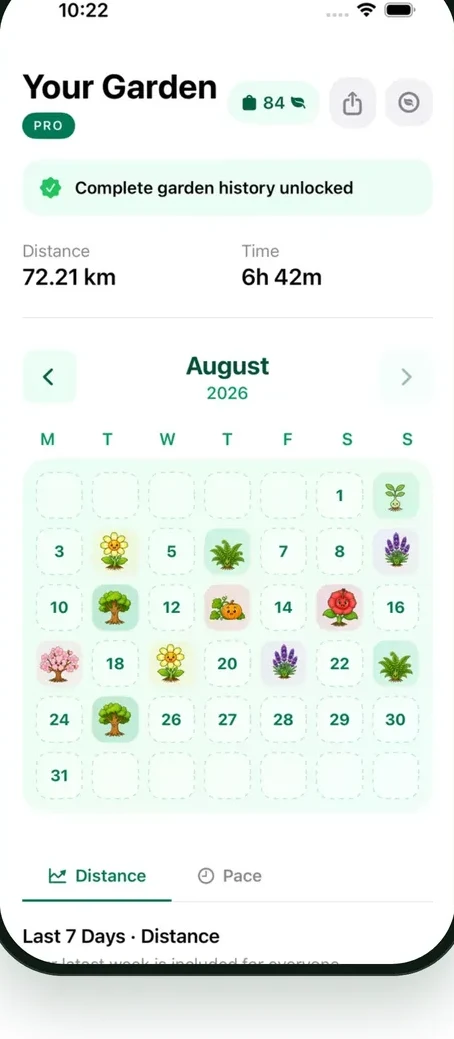
The hardest part is not one workout, it is the months of easy runs in between. That is where Run&Grow helps: every GPS run grows a plant in your garden, so an easy jog counts just as much as a hard session. It reads runs from Apple Health, so runs saved from your Apple Watch or another app count too. No public feed and no pace shaming.
Nearby times and tools
25-minute 5K · 30-minute 5K · 8-minute mile · How long to run 3 miles · 1-hour 10K · Average 5K time · Pace calculator · Race time predictor · Age grade calculator
Frequently Asked Questions
- Is a 20 minute 5K good?
- Yes, it is a very good time. A 20-minute 5K is 4:00 per km (6:26 per mile). That is 19:02 faster than the average US 5K finisher (39:02) and, by our rough estimate from US race results, faster than about 94% of men and 98% of women.
- What pace is a 20 minute 5K?
- 4:00 per kilometre, or 6:26 per mile. On a treadmill that is 15.0 km/h or about 9.3 mph. Each 400 m lap of a track takes 1:36.
- Is a sub-20 5K hard?
- For most people, yes. It needs 3:48 per km for a 19-minute 5K, or just under 4:00 per km to sneak under 20. Many runners train for a year or more to get there. If you run about 22 minutes now, it is a realistic goal with steady training.
- Is a 20 minute parkrun good?
- Yes. As of August 2025 the average parkrun time was 29:30 in the UK, 33:25 in Australia and 34:16 in the USA, with walkers included. A 20-minute parkrun is 9:30 ahead of the UK average and will often put you near the front of the field.
- What marathon time does a 20 minute 5K predict?
- The Riegel formula predicts about 41:42 for a 10K and 3:11:49 for a marathon from a 20-minute 5K. That assumes you have trained for the longer distance; most people run a bit slower than the formula in their first marathon.
Tracking your 5Ks with adidas Running and thinking about a change? See our adidas Running alternatives for free and paid options.
Run&Grow · free iPhone app
Keep running, keep growing
- Free on iPhone
- Reads your runs from Apple Health
- No public feed, no pace shaming
4.6 on the App Store